Context: Company project — MWSC apprenticeship
Status: WAGO communication confirmed on a bench; EQIOM cables fabricated and test logic developed
Context
At MWSC, I use test benches to find out how equipment can be connected, adapted or reused before changes are made on site. Depending on the assignment, I configure industrial networks, build hardware interfaces or write PLC test logic. The cases below show how I apply that work to different integration problems.
My role
Equipment integration, PLC development and bench testing.
Technologies
Beckhoff–WAGO communication
Need
Could we keep the existing WAGO I/O and field wiring when fitting a Beckhoff controller in a concrete batching plant? Reusing them could save rewiring work and the cost of replacement I/O cards.
My contribution
- I assembled the setup and PROFIBUS connection: Beckhoff CX + EL6731 PROFIBUS master → PROFIBUS → WAGO 750-323 I/O coupler → WAGO I/O modules.
- I integrated the coupler in TwinCAT 3 using its GSD file, configured the modules in their physical order, and set the station address and bus speed.
- I mapped the I/O to Beckhoff programme variables, diagnosed communication states and BF bus faults, and worked on the I/O test programme.
- I documented the configuration in a reusable procedure.
Technical difficulty
I made up both ends of the PROFIBUS cable myself. At first the Beckhoff controller could not see the WAGO coupler. I traced the problem to the bus termination at the connectors. Once I corrected it, the station appeared and I could exchange data on the bench.
Result and status
Status: Communication confirmed on the test bench — configuration documented
- I demonstrated communication on this bench and documented the configuration for the team. This was my first experience taking an open R&D question through to a working bench test.
Limits of this work
- This confirms the bench integration only. Plant deployment, endurance testing and universal compatibility with WAGO equipment are not established.
EQIOM adapter cables and functional testing
Need
Prepare an OMRON-to-Beckhoff migration for EQIOM by adapting the existing 20/40-channel connections to the new I/O cards, including EL1862 inputs and EL2872-0010 outputs.
My contribution
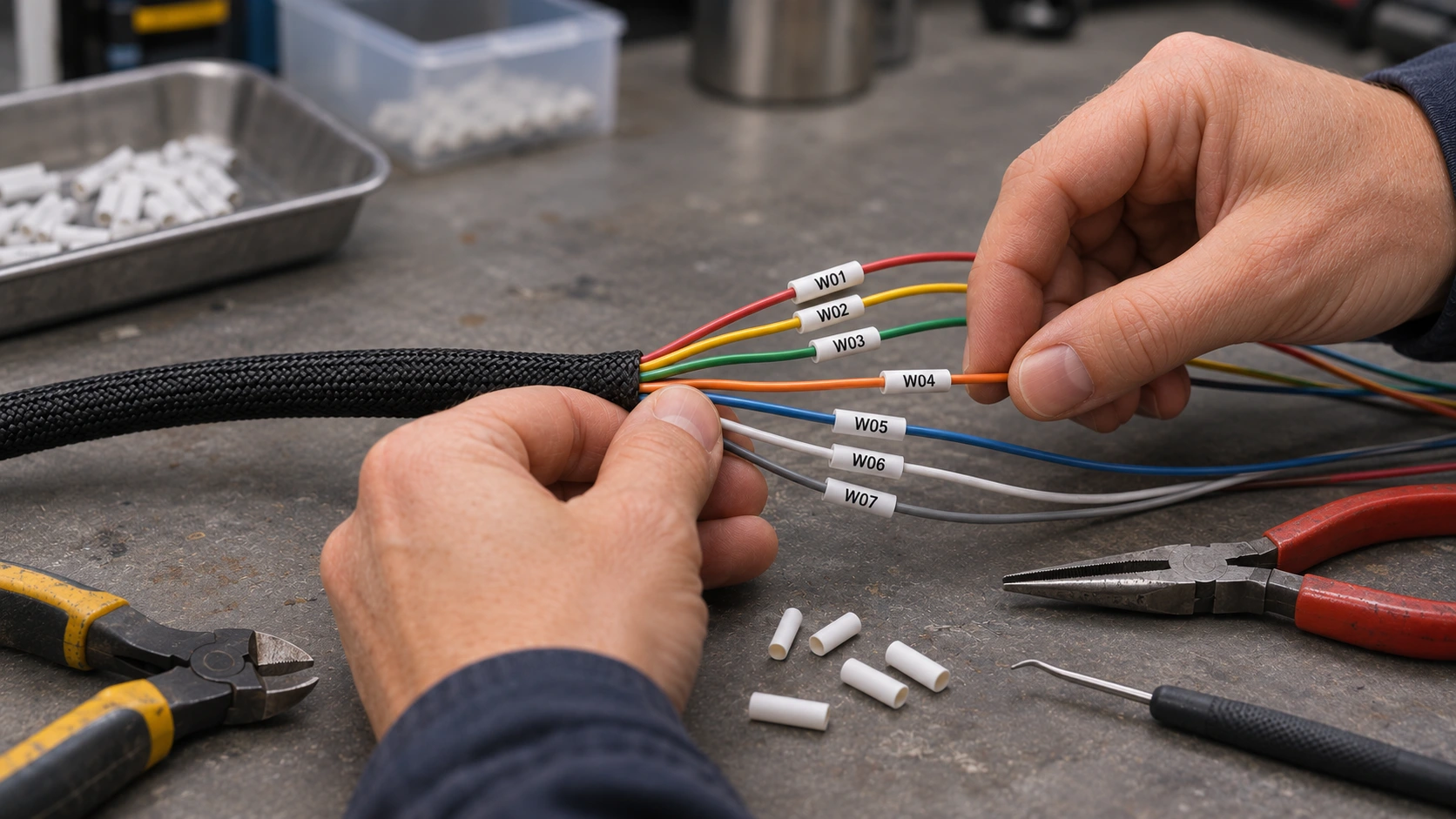
- I studied the correspondence between the existing connections and the new I/O, identified conductors, pins and channels, and fabricated the adapter cables while preserving the exact signal assignments.
- I developed sequential TwinCAT test logic for a planned setup of sixteen outputs, each connected to two inputs: thirty-two monitored inputs in total.
- The intended sequence activates outputs one by one at approximately one second per channel, checks the two associated inputs and stops on the affected channel if an expected response is missing. With no anomaly, it continues and repeats the cycle.
Technical difficulty
Manual cable fabrication was particularly time-consuming and demanding. I had to maintain conductor identification, connection order and exact pin-to-channel correspondence throughout the assembly, then prepare a repeatable functional check to help locate a channel that does not respond.
Result and status
Status: Adapter cables fabricated — functional test logic developed
- The established work covers cable fabrication and development of the checking method. The planned cadence is a test-sequence setting, not a guaranteed performance result.
Limits of this work
- This functional check cannot distinguish a swap between the two wires in a pair receiving the same signal, so it does not detect every possible pin-assignment error or provide complete electrical certification.
- The existence of the programme does not prove that every cable has completed a full test campaign. Complete plant migration and production validation are not established.
Related project
My R&D work also includes integrating PRECIA weighing equipment with Beckhoff control systems. This work is presented in a dedicated case study.