Mechatronics
2026
Context: Academic team project
Status: Team prototype — functional validation reported in the project presentation
Context
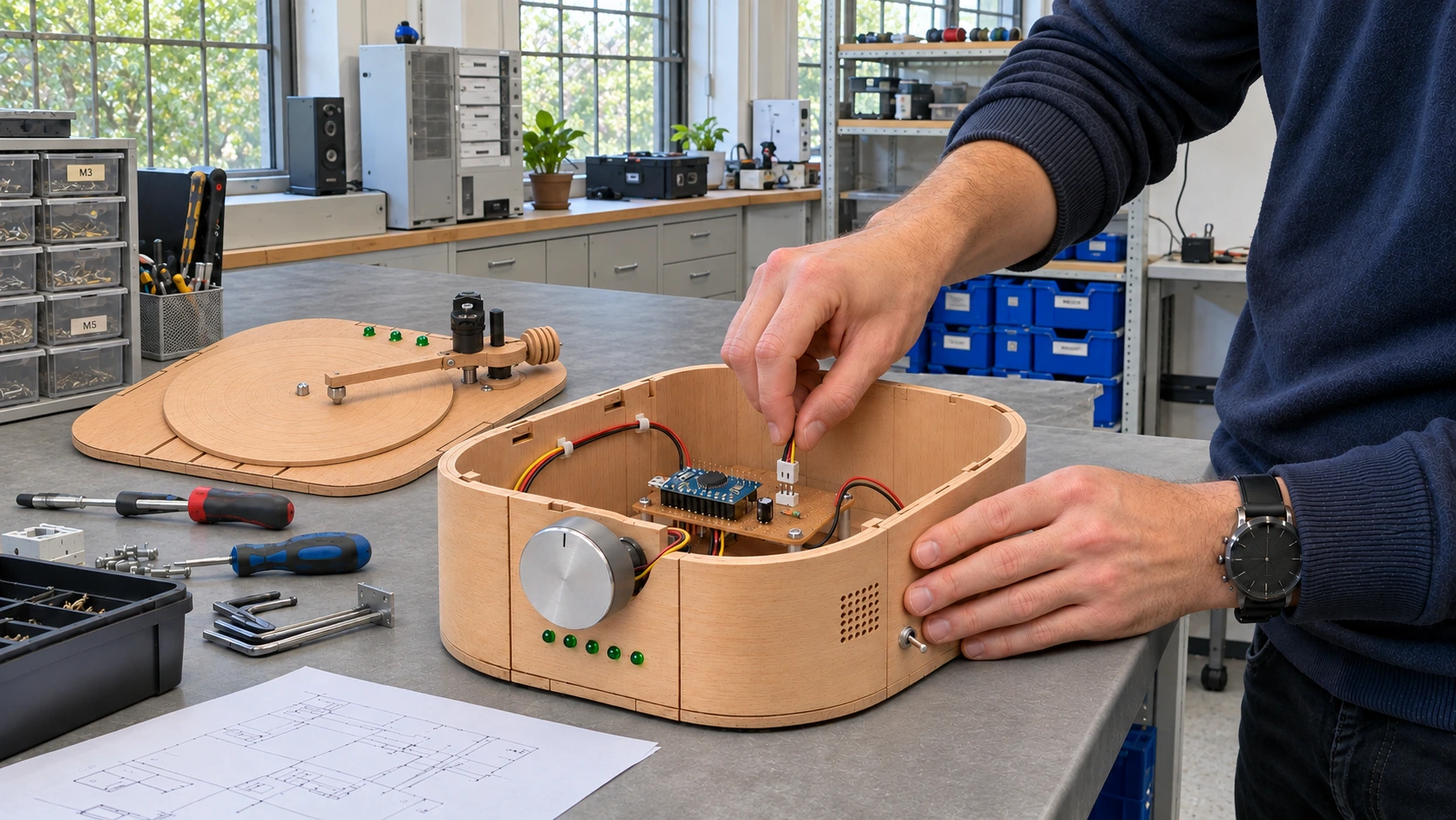
This 2026 academic mechatronics project combined analogue and digital electronics, embedded programming, user controls and mechanical integration. Working in a team of five, we developed a three-key monophonic keyboard in a record-player-inspired object. The specifications provided the general electronic architecture and prescribed much of the circuitry; the project was a collective implementation and integration effort.
Objective
Integrate note generation, user controls, embedded logic and physical construction into a working mechatronic system.
My role
Mechatronics design, prototyping & integration — team project.
Technologies
Analogue electronics
Mechanical design
Arduino Nano
Embedded programming
CD4051B
MCP6542
Prototyping and functional testing
My contribution
- My contribution spanned electronics, mechanical design, Arduino programming, fabrication, assembly, wiring and functional testing.
- Working with the team, I helped develop and implement the circuits and their interfaces, the enclosure layout and the physical integration of the components.
- I developed the Arduino programme for button handling, note selection, operating modes, frequency measurement and note-sequence recording and playback.
- I participated in fabrication, assembly and wiring, as well as integration tests, debugging and collective troubleshooting.
- We tested each circuit separately before assembling the piano. When a previously working assembly fell silent, we followed the signal on the oscilloscope to the Wheatstone bridge. I spotted a resistor that was connected incorrectly.
- I adjusted my Arduino code against the assembled hardware until the notes played in the intended order and we could record and replay the sequence.
Approach and technical considerations
- Three notes — A, C and E — are generated by analogue astable circuits and filters. Only one note is played at a time; the Arduino Nano selects the signal through the CD4051B multiplexer for amplification and the loudspeaker.
- The MCP6542 comparator provides a frequency-measurement signal; the Arduino sends frequency and state information to a PC over a serial connection.
- The arm moves a potentiometer: physical movement becomes an electrical input that selects normal playing, recording or timed playback in the software. This is one example of the interfaces I helped integrate across the system.
- The record-player-inspired concept includes a decorative motor-driven disc, arm, volume control and loudspeaker, with an enclosure planned in MDF. The disc is not read acoustically.
- Team troubleshooting addressed multiplexer signal amplitude, filter sizing and intermittent breadboard contacts. I participated in this collective development and testing work.
Work carried out
- Collective electronic and mechanical design, prototyping, physical assembly, wiring and system integration, with my active participation across these areas.
- Arduino software for debounced buttons, single-note selection and MUX inhibition for silence, three modes, frequency reporting, and sequence control.
- A RAM sequence of up to twenty note identifiers, with full-memory and empty-sequence handling, for timed playback.
- Software features for mode indicators and a five-LED display calculated from the measured analogue peak-to-peak amplitude.
Observed results
- The team presentation reports validation of three notes played individually and button/MUX selection.
- It also reports frequency measurement with PC display and recording/playback of sequences of up to twenty notes.
Limits of this work
- The reported results come from the team project presentation; no new independent hardware test was performed for this portfolio.
- The presence of a feature in the described V4 programme does not prove that every feature was validated on the hardware in that exact version. No measured latency, audio quality, frequency precision or LED calibration is claimed.
- Recording stores note identifiers in RAM, not audio or MIDI. The sequence is not retained after power-off.
- This was a collective academic prototype based on a supplied electronic architecture, rather than a commercial or professional piano.